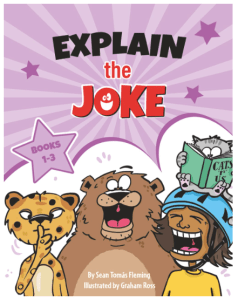
I began explaining jokes to my students in 2013. They were learning English and did not understand the jokes that other students were telling. While the book was written for English language learners, it works for anyone who would like to better understand the multiple layers of these jokes in English.
Of course, I would encourage you to share this post with everyone you know, and you can certainly buy a copy of the book if you like. I hope you enjoy reading the book! Be sure to let me know what you think.
Q: What kind of dog doesn’t bark? A: A hush puppy!
Explanation: You already know what a dog is. According to the American Kennel Club, there are over 340 breeds of dogs in the world. A breed is a type of dog like a Poodle or a German Shepherd. The sound that a dog makes is called a bark. When it is written, you might see words like “arf,” or “woof,” or “bow wow” to show that a dog is barking.
In English, baby animals have names that are different from the adult animals. A baby cat is a kitten, a baby rabbit is a bunny, and a baby dog is a puppy. If you would like a list of other baby animal names you could start here.
When you tell someone to hush, you are telling them to be quiet. Often people will put their index finger in front of their lips and say, “Shhhh!” when they want you to hush.
A hush puppy, on the other hand, is a type of fried food made with cornmeal. Hush puppies are often served with shrimp, catfish, or a barbecue sandwich, according to Southern Living. I would encourage you to try them if you are able to; they are quite tasty!
This joke is funny because it plays with the words hush puppy (telling your baby dog to be quiet) and hush puppies (a type of food).
If you would like to try making some hush puppies, here is a video that can show you how:
Q: Why did Beethoven get rid of all of his chickens? A: All they ever said was, “Bach, Bach, Bach!”
Explanation:Beethoven is one of the most famous classical composers. He was born in Bonn in 1770. Bach is also a famous classical composer; he was born in Eisenach in 1685, and died about 20 years before Beethoven was born.
If you say, “Bach, Bach, Bach” it sort of sounds like the noise that a chicken makes. In English, animal sounds are written/said in certain ways: Dogs bark, cats meow, birds chirp and tweet. Typically, in English chickens cluck. Of course, in other languages the way animal sounds are written/said are different. (In Spanish there is a song that says, “Los pollitos dicen pio, pio, pio. Translated that is, “The little chickens say pio, pio, pio.” In English, no one would ever say that a chicken says “pio.”)
This joke is funny because you can imagine a famous classical composer not wanting to hear the name of his competition all day long. There is no indication, that I am aware of, that Beethoven and Bach were competitors. Both were brilliant, and very different.
Q: What do the Eiffel Tower and wood ticks have in common? A: They are both Paris sites/parasites!
Explanation: Happy Father’s Day!
The Eiffel Tower is perhaps the most well known tourist site in Paris, France; it is visited by more than six million people each year. (The Louvre, though, is visited by more people each year.)
Wood ticks are insects that attach themselves to animals, including humans, and suck their blood. This type of insect is known as a parasite. It is important to remove a tick from your body, or your dog’s body, as soon as possible because they can transmit diseases. Deer ticks can be more dangerous because they can transmit Lyme disease.
This joke is funny because Paris site (like the Eiffel Tower) and parasite (like a wood tick) sound the same. You can file this joke under dad jokes for Father’s Day.
In addition to being the title of a movie, the phrase “We’ll always have Paris” is an important line from the end of the movie Casablanca–
“Yogurt is a dairy product made with milk and fermenting cultures” (Medical News Today). Those cultures are bacteria that help the milk ferment and produce yogurt. Yogurt is often mixed with fruit (I think because it tastes sweeter, less acidic, that way), but often times eaten plain.
Culture refers to the beliefs, behavior, and creations of a group of people. Many people will go to a museum to learn about the culture of a group of people. That might include a history museum or an art museum.
This joke is funny because it plays with different meanings of the word culture: The bacteria that help make yogurt, and the collection of beliefs, behaviors, and creations of a group of people. By the way, humor and learning are both very cultural, so you are participating in culture right now!
Q: Why don’t people trust stairs? A: Because they’re always up to something!
Explanation: Do you take the elevator or do you take the stairs? Well, most of the places I go do not have elevators, but when they do, I usually take the stairs (unless the building is really tall and I have to go to an upper floor!). There are lots of reasons to take the stairs. Take the stairs is an idiom meaning walk up or down the stairs; it is similar to take the bus.
Up to something is also an idiom. If you are up to something, it means that you are planning something or involved in something, probably something bad. A parent might say, “The kids are really quiet right now; I hope they’re not up to something.” Up to something is not always bad. I might say, “I knew my friends were up to something when everyone was too busy to for dinner on my birthday.”
This joke is funny because it plays with the idea of up to something. Stairs literally go up to an upper floor, while people who are planning something are up to something and you might not trust them.
Here are some Looney Toon characters who are up to no good:
Q: What do dentists call their X-rays? A: Tooth-pics!
Explanation: I have never enjoyed going to the dentist, but it is necessary. Every few years my dentist takes an X-ray of my teeth using those cardboard bitewings to get a good image of my teeth, and make sure there are no hidden cavities. X-rays use a small amount of radiation to see inside our bodies, and are really good for seeing teeth and bones.
A toothpick is a small piece of wood or plastic that is used to remove small pieces of food from between your teeth.
This joke is funny because it plays with the words tooth-pic (a picture of your teeth, pic is a shortened version of picture) and toothpick.
Q: Why are plants so skinny? A: Because they eat lite!
Explanation:Skinny means thin or lean; the opposite of skinny could be obese, fat, or chubby. The stem of most plants is thinner than a finger, so yes plants are typically thin.
Someone who eats lite is someone who does not eat very much, or eats certain foods that are lower in calories. You may have seen foods that are labeled lite or light. Companies who sell those foods want people to think that those foods are more healthy, although sometimes, perhaps many times, they are not.
The word lite sounds the same as the word light. In your middle school science class, you may have learned about photosynthesis. Photosynthesis is the ability of plants to take sunlight and transform it into sugars that the plant can use as food. So, if you think about it, plants are absorbing, eating, the light and making their own food.
This joke is funny because it plays with the word lite/light, and how it relates both to eating and photosynthesis.
Thinking back to when I was in middle school, there was a scary movie called Poltergeist where a child was told to run to the light (if you don’t like scary movies, please do not watch this movie clip).
Q: When is dining out just like school? A: When it’s a four course meal!
Explanation: When you go to a restaurant, you are dining out. Dining out, eating out, and going to a restaurant for a meal all mean the same thing. When you say that you are dining out, it probably means that you are going to a restaurant with servers who take your order and bring you your food; dining out is more formal than going to a fast-food restaurant.
Often, restaurants will offer meals with multiple courses. In dining, a course means a type of food that is served at one time. Typical courses are appetizers, salad, the main dish, and dessert. There can be lots and lots of courses in a meal. (This is why sometimes there are many forks on the table at a really fancy restaurant!)
In school, a course is unit that may last a semester, a year, or another length of time. You might have a year-long history course or a semester-long philosophy course. Frequently, college students take four courses in a semester, although they can take more or fewer.
This joke is funny because it plays with two meanings of the word course: A meal course and a school course. Of course there are other courses such as a golf course and the course of a river (its path).
Q: Why did the bat miss the school bus? A: He hung around too long!
Explanation: First of all, let’s be clear: Bats don’t go to school. Although, bats might make their home in the attic of a school or any building if there is a way to get inside.
In this joke, when you miss the school bus, it means that you arrived too late to take the bus. There are other meanings of miss the bus: If you really liked taking the bus and you no longer take it, you might miss the bus, just like you might miss someone who is not with you; if you were trying to hit the bus with a snowball (don’t do this!), you could miss the bus when you throw the snowball and the snowball does not hit the bus.
To hang around means that you spend time with people, maybe talking, maybe not doing much of anything. If you hang around too long, that means that you are spending too much time at a place and you will be late for whatever comes next. Bats, of course, hang upside down when they sleep. That is, they grab a branch from a tree, or something else, with their feet, and they hang with their heads toward the ground (the opposite of standing on your feet).
This joke is funny because it plays with the words hang (hung in the past), like a bat sleeping, and hang around, like spending time not doing much of anything.
Here is a short video about bats landing upside down:

 Explain the Joke